 |
 |
 |
 |
 |
 |
 |
 |
 |
 |






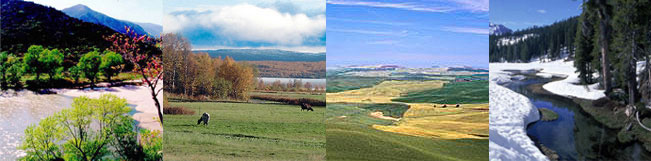
| Description The reference area is located in Euregio Silva Nortica, which is a Czech-Austrian regional units covering districts Jindrichuv Hradec, Èeské Budejovice, Pisek and Tabor on Czech side (Tøeboò Basin) and districts Zwettle, Krems, Gmund, Waidhofen an der Thaya and Horn on Austrian side. The Austrian part of the area (Waldviertel) is a hilly terraine with forests while Czech part is mainly basin region with developed human activities, unique landscape features (ponds and artificial channels in Trebon system) and dynamically developing society. The Czech area has agricultural and touristic character with traditional fish-ponding and many cultural and natural sightseeings. The Austrian part is formed by mountain plateaus with small agricultural and forestry enterprisings and developing ecotourism. Trebon Basin is a mostly flat inland plateau (403-550 m a.s.l.) rich in both surface and ground water. Geological structure composed mostly of sedimentary rocks surrounded by crystalline rocks of the Bohemian Massif in southern part of the reference area in Weinviertel with elevations up to 700 m a.s.l. Semi-natural landscape with valuable natural ecosystems within the core area that was influenced by human activities for more than 8 centuries and can serve as an example of sensitive human interventions into nature. Centre of Czech fish-farming industry (460 artificial fish-ponds and lakes). Forests cover about 50 % of the area. Vast peat bogs. Diversity of wetland vegetation and waterfowl. Very good conditions for recreation. Major Biome is temperate broad-leaf forests. Main ecosystems are fish-ponds, wetlands (fishpond littoral zones, alluvial wetlands, acidic fens, transitional peat bogs, wet meadows), forests (Scots Pine, Norway Spruce, Oak, Beech, Alder, Willow), xerophytic sand dunes, meadows, agroecosystems. Main economic activities: fish-farming (carp), agriculture, forestry, extraction of sand and gravel, light industry (timber manufacturing, building materials, textile, glass, brewery), tourism, spa. Trebon Basin (Trebonsko) is a declared biosphere reserve and a protected landscape area (BR/PLA) of regional size totalling 700 km2, of which a major part is included in the reference area. Besides this environmentally protected area there are further environmentally protected sites, probably the most valuable being three wetlands of international importance protected by the Ramsar Convention (Ramsar Sites) within the reference area. The first site, Trebon Fishponds, covers 159 fishponds, with sizes ranging from 1 ha to 490 ha, and surrounding wetlands. The total size of the Ramsar Site Trebon Fishponds is 10165 ha. The second site, Trebon Peatlands, comprises four locations of transitional peatbogs mostly covered with forest. The total size of the Ramsar Site Trebon Peatlands is 1100 ha . Recently, the third Ramsar Site has being declared in the Lainsitz Valley between the town of Gmünd and the Austrian-Czech border, covering the area of 135 ha. Besides these there are numerous further protected areas on both sides of the border. Large portion of the study area on the Austrian side has been declared a member of the European Natura 2000 network as the Waldviertel pond, plain and peat landscapes. Large areas of the Waldviertel region are covered by forests, mostly managed commercial forests with a high percentage of coniferous trees. Although natural coverage has been altered through human use for centuries (clearings, forest grazing, harvesting of fire wood) some parts are still of high environmental value. Motivation Since the fall of "Iron Curtain" (the border between former Czechoslovakia and Austria), the economy of the reference area has developed significantly. There are some advantages and risks of the rapid development. Therefore the best management of the economic, social and agri-environmental development should be build. The goals of such management framework would be sustainable land and fishery management, optimisation of the agricultural activities and surface as well as ground water management. Desirable ways of local development include reasonable forest management aimed at improving of the ecological stability of forests, low-intensity agriculture, sustainable low-intensity fish-farming, processing of local resources in local small-scale industry (timber, fish, agricultural products, sand), "soft" tourism including spa, tourism and modern light industry with acceptably low impact on nature and landscape. Economic changes in Austria related to the fall of "Iron Curtain" are less pronounced compared to the Czech area. The economic development of the Austrian border region was not influenced much for the first years, while beginning long-term economic processes and slowly increasing trading with the Czech Republic can be observed over the last few years and these processes are expected to speed up significantly in the future. This situation provides nearly unique insights and input into models of future development of economic-ecological interrelations and integrated water management model development. |